
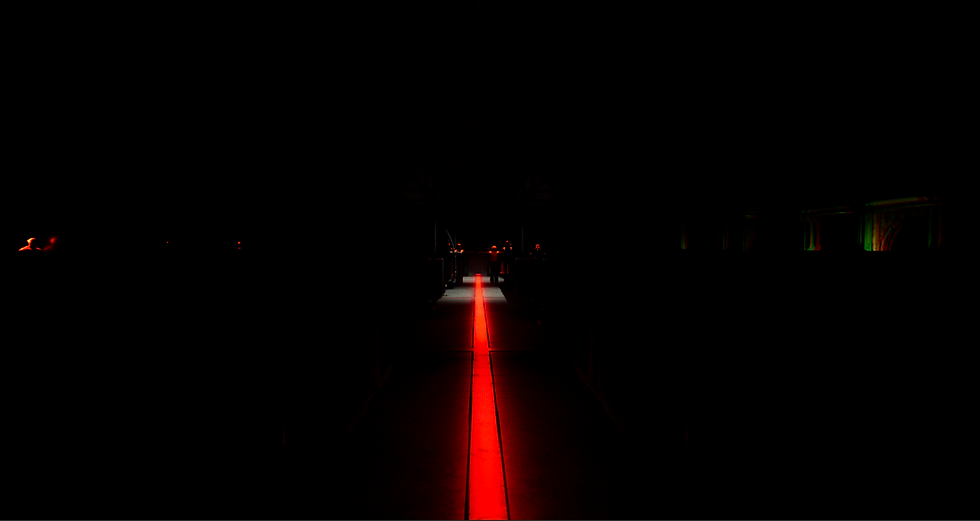

trAIn: Denial TrainCar
Beginning in May 2022 and ending in July 2022. Survival Horror game narrative sequence.
Project Details
Project Length: 4 Months
Software Used: Unreal Engine 5, FadeIn
Group Size: 8 People
Experience Level: Beginners
Responsibilities
Narrative Design:
-Scriptwriting
-Enemy Concepts
-Gameplay Loop
-Cinematic Sequences
Level Design:
-Environment Design
-Lighting
-Greyboxing
trAIn - Denial Sequence
In trAIn, players would navigate semi-open sandbox areas in search of resources to keep themselves alive and their train moving. Each of these survival horror sections was to be broken up with cinematic horror experiences slated to take place during the moments of quiet the player was meant to experience transitioning from level to level.
When helping to design trAIn, my main responsibilities were to develop the central narrative that players would experience and design these cinematic sequences, later referred to as Train Cars, as a storytelling device to help show the effects of the main characters' perilous journey.
Inspirations
Having not worked or experienced much in the way of horror stories before this project, my process of creating these sequences started with a brief education on how psychological horror works compared to more traditional jump scares. This process started with reading articles about classic horror cinema, viewing some of these films, and, most importantly, looking at how colour and lighting could tell a story.
The initial sources of inspiration included Alfred Hitchcock's Psycho, The Batman by Matt Reeves, Control by Remedy Games and The Beginner's Guide by Davey Wreden. Each of these films and games used their environments to tell a dozen hidden stories while their main narratives played out, but they each stuck out in my mind for making the most out of the idea that your audience needs to really see what's going to terrify them.
Narrative Process
After considerable deliberation with the rest of my team, we hashed out a basic story: a rogue AI has hijacked the minds of most of the world population and you, the player, must journey to the heart of this evil creation city to deactivate it. Along the way, you experience more of the horrors generated by this mechanical monstrosity and fight against your own psyche and loneliness during those moments of quiet between each fresh hell the game presents to you.
Due to the time restrictions and our ability to create new levels, I focused more on the smaller, more personal horror experiences. I was told I'd need about five of them planned, so I got to work trying to figure out how to incorporate Resident Evil-style horror exploration into a game full of strange gadgets and higher tension.
This ideation process started with treating the game like it was a descent. The player starts on the outskirts of the world, away from the evil, but slowly has to get deeper and deeper into it. Each level was a step down into the Inferno, but the Divine Comedy (Dante's Inferno) didn't fit what I sought. This wouldn't be an exploration of the world's mistakes; these sequences would be the last person on earth slowly losing their mind.
After more thought and a half-dozen ideas thrown at the wall, the idea hit me: five train cars, five stages of grieving. After that, it all became clear to me. As the player got deeper into the world's insanity, they'd experience the loss of it all in the most human way possible by grieving. So, the Train Car Sequences were divided into the five stages of grief: denial, anger, bargaining, depression, and acceptance.
01
Greyboxing
I began my design by creating a simple layout for the sequence. I then used lighting and custom controls to test how the player would feel as they moved through specific zones.
02
Documentation
After the initial conception Greybox was completed, I moved on to finalizing the design idea with a simple GDD. I included a breakdown of what the level should symbolize (Denial, in this case) and wrote down some ideas to add to the existing proof of concept.
03
Second Pass
After the documentation was finished, I redid the Lighting to get a better sense of how the would feel when moving through the space. This involved having my fellow teammates perform Playtests alongside some questions about how the experience made them feel.
With all this feedback, I moved onto creating the final experience.
04
Finalization
Using the feedback from the Playtests, I began replacing the greyboxed assets with others from the free packs provided through the Unreal Engine marketplace. This required an additional Lighting pass as I fully implemented the Blueprint side of the project. The experience required collision-activated lights as well as a change of behaviours from the silent NPCs lining the subway car.
Once the process was complete, the Denial Train Car was ready to be added into the flow of gameplay.
trAIn Team Credits
GAMEPLAY - Ntigya Chung, Harry Marshall, Timothe Lafond, Neh Kulin, Shaheen Dotteridge
LEVEL DESIGN - Harry Marshall, Timothe Lafond, Shaheen Dotteridge
AI - Ntigya Chung, Neh Kulin, Sergio Alexander Mendieta Arias
NARRATIVE - Harry Marshall, Jayson Martin-Miron
3D MODELING - Felipe Munoz, Patrick-John Villanueva-Malard